 www.biofortified.org
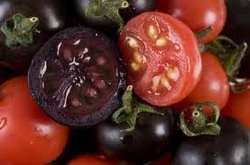
 A new genetically modified purple tomato is closer to being offered for sale. Although the research was developed in Britain, Canada has produced the purple tomatoes with first 1,200 liters of juice ready for shipping back to Britain. The aim is to use the tomato juice in research.
The new tomatoes could improve the nutritional value of ketchup and pizza topping. Their dark pigment is intended to give tomatoes the health benefits found in fruit such as blueberries. The purple pigment is the result of the transfer of a gene from a snapdragon plant—the modification triggers a process within the tomato plant allowing the anthocyanin to develop.
That sounds scary—the transfer of genes. What if they somehow jump into humans?
Scientists scoff at the irrational fear. They aim to conduct a wide range of tests. Earlier studies show benefits as an anti-inflammatory and in slowing cancers in mice. Now, they want to test if the anthocyanin has positive effects on humans.
The new tomatoes could improve the nutritional value of ketchup and pizza topping. Their dark pigment is intended to give tomatoes the health benefits found in fruit such as blueberries. The purple pigment is the result of the transfer of a gene from a snapdragon plant—the modification triggers a process within the tomato plant allowing the anthocyanin to develop.
That sounds scary—the transfer of genes. What if they somehow jump into humans?
Scientists scoff at the irrational fear. They aim to conduct a wide range of tests. Earlier studies show benefits as an anti-inflammatory and in slowing cancers in mice. Now, they want to test if the anthocyanin has positive effects on humans.
 www.thesun.co.uk
 A key question is whether the health benefits will influence public opinion.
Researchers in the UK hope that the purple tomato juice will have a good chance of being approved for sale to consumers in North America in as little as two years' time.
In the last 20 years, 28 countries have cultivated them on a commercial scale, and many hundreds of millions of people now safely eat GM food on a regular basis without being aware of how their food is produced. No person or animal has died or fallen ill directly as a result of eating GM food. Contrary to the pro-organic lobby's claims, it is actually more dangerous to eat organic food. In 2011, 53 people in Germany died from eating organic beansprouts.
I'd rather eat natural foods—foods that are grown in or on the Earth, do no harm to the environment, and have been around since the time of our ancestors. However, I've got to admit that if we opposed everything unnatural we wouldn’t practice medicine for a start. We'd just shrug and give in to nature. Then I, for one, wouldn't be here.
Genetically modified food has slipped into the food chain in the U.S. I'd be interested to find out how many foods we are eating without knowing they contained a genetically modified ingredient.
Researchers in the UK hope that the purple tomato juice will have a good chance of being approved for sale to consumers in North America in as little as two years' time.
In the last 20 years, 28 countries have cultivated them on a commercial scale, and many hundreds of millions of people now safely eat GM food on a regular basis without being aware of how their food is produced. No person or animal has died or fallen ill directly as a result of eating GM food. Contrary to the pro-organic lobby's claims, it is actually more dangerous to eat organic food. In 2011, 53 people in Germany died from eating organic beansprouts.
I'd rather eat natural foods—foods that are grown in or on the Earth, do no harm to the environment, and have been around since the time of our ancestors. However, I've got to admit that if we opposed everything unnatural we wouldn’t practice medicine for a start. We'd just shrug and give in to nature. Then I, for one, wouldn't be here.
Genetically modified food has slipped into the food chain in the U.S. I'd be interested to find out how many foods we are eating without knowing they contained a genetically modified ingredient.
 www.ag.hdsu.edu
 Experts say 60% to 70% of processed foods on U.S. grocery shelves have genetically modified ingredients. The most common are soybeans, maize, cotton, and rapeseed oil. That means many foods made in the U.S. containing field corn or high-fructose corn syrup. These include many breakfast cereals, snack foods, and soda. Foods made with soybeans (including some baby foods) or cottonseed and canola oils could contain genetically modified ingredients.
The U.S. government's position: Genetically engineered crops are safe, resist disease better, and can provide much-needed food in starving nations.
The EU position: Keep it out. We prefer organic, which is much healthier. The risk of genetically modified foods to health and the environment outweigh the benefits. Only the multinational companies will benefit, dominating the world food supply and squeezing out traditional farmers.
The U.S. government's position: Genetically engineered crops are safe, resist disease better, and can provide much-needed food in starving nations.
The EU position: Keep it out. We prefer organic, which is much healthier. The risk of genetically modified foods to health and the environment outweigh the benefits. Only the multinational companies will benefit, dominating the world food supply and squeezing out traditional farmers.
 www.perham.com
 At the moment, the US is the largest producer of genetically modified crops. Many countries have followed including Argentina, Canada, China, Australia, India, and Mexico.
The term genetically modified food (also known as biotech or genetically engineered food) refers to crop plants that have been modified in the laboratory to enhance desired traits, such as resistance to herbicides or improved nutritional content. Experts say this science, like any other, has no guarantees.
Risks include:
1. Introducing allergens and toxins to food
2. Accidental contamination between genetically modified and non-genetically modified foods
3. Antibiotic resistance
4. Adversely changing the nutrient content of a crop
5. Creation of "super" weeds and other environmental risks
GMOs have not introduced any unique allergens or toxins into the food supply. All GM crops are tested against a database of all known allergens before commercialization and any crop found containing new allergens is not approved or marketed.
When we look at the subject logically, there is no credible evidence that GMOs pose any unique threat to the environment or the public’s health. So, who's going to volunteer for test-drinking purple tomato juice?
The term genetically modified food (also known as biotech or genetically engineered food) refers to crop plants that have been modified in the laboratory to enhance desired traits, such as resistance to herbicides or improved nutritional content. Experts say this science, like any other, has no guarantees.
Risks include:
1. Introducing allergens and toxins to food
2. Accidental contamination between genetically modified and non-genetically modified foods
3. Antibiotic resistance
4. Adversely changing the nutrient content of a crop
5. Creation of "super" weeds and other environmental risks
GMOs have not introduced any unique allergens or toxins into the food supply. All GM crops are tested against a database of all known allergens before commercialization and any crop found containing new allergens is not approved or marketed.
When we look at the subject logically, there is no credible evidence that GMOs pose any unique threat to the environment or the public’s health. So, who's going to volunteer for test-drinking purple tomato juice?







 RSS Feed

