 www.cheshirelife.co.uk
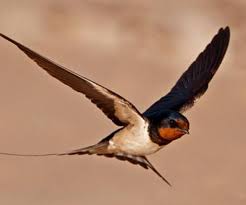
 Swooping and diving, tail feathers streaming behind, swallows are the symbols of the British summer. But the birds face a growing danger. Due to population declines across Europe in the last 30 years, the species is already amber listed. But now, along with 15 other insect-eating species, they face a new threat from a controversial pesticide. Apparently, imidacloprid is the world’s most widely used farm insecticide.
What are we doing to the Earth?
A Dutch study released yesterday suggests that the insecticide's effect travels up the food chain to effect birds such as swallows, starlings, skylarks and yellowhammers.
About twenty years ago before I left the country, Australians considered starlings to be a pest. Brought over with the first settlers, starlings, foxes and rabbits, among other imported creatures, quickly multiplied in a country with very few predators. But what's been done in the past can't be altered. Let's concentrate on keeping the present safe.
Published in the journal Nature, the study came right after separate research found the insecticide also harms the ability of bees to find pollen. Crops need to be fertilized. Everything depends on everything else in this world—measures and counter-measures. Surely those who use the pesticides should be required to acknowledge the harm it causes to bees, soil and water, and now birds.
What are we doing to the Earth?
A Dutch study released yesterday suggests that the insecticide's effect travels up the food chain to effect birds such as swallows, starlings, skylarks and yellowhammers.
About twenty years ago before I left the country, Australians considered starlings to be a pest. Brought over with the first settlers, starlings, foxes and rabbits, among other imported creatures, quickly multiplied in a country with very few predators. But what's been done in the past can't be altered. Let's concentrate on keeping the present safe.
Published in the journal Nature, the study came right after separate research found the insecticide also harms the ability of bees to find pollen. Crops need to be fertilized. Everything depends on everything else in this world—measures and counter-measures. Surely those who use the pesticides should be required to acknowledge the harm it causes to bees, soil and water, and now birds.
A spokesman for Bayer CropScience, the inventors of the pesticide, said: “Neonicotinoids have gone through an extensive risk assessment which has shown that they are safe to the environment when used responsibly.”
A spokesman for the Department for Environment, Food and Rural Affairs said: “Pesticide use is tightly regulated to protect the environment – they are a safe, effective and economical means of managing crops.”
 en.wikipedia.org
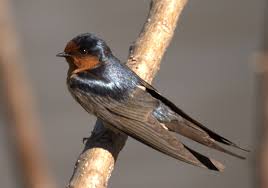
 But back to the charming swallows. The small birds have dark, glossy-blue backs, red throats, pale underparts and long tail streamers. Spending most of their time in the air, they pluck insects from the air as they go. To rehydrate whilst flying they skim the surface of rivers and streams. The birds breed in the Northern Hemisphere, and then migrate south in winter.
As a ten-year-old child, I remember a radio broadcast of Oscar Wilde's story, The Happy Prince, in 1952. I'll never forget the words. The lines from the novel ring in my memory. 'Swallow, swallow, will you not stay with me for one night?' It's a wonderful story, meant to be spoken aloud to children. You can read it in full here.
It seems to me that feeding the human population has grown out of all proportion, to the detriment of every other creature who shares the planet.
Around us here in Hertfordshire, England, crops sway in the fields. I don't know what the farmers are spraying on them. I'm culpable. Do you have a solution?
As a ten-year-old child, I remember a radio broadcast of Oscar Wilde's story, The Happy Prince, in 1952. I'll never forget the words. The lines from the novel ring in my memory. 'Swallow, swallow, will you not stay with me for one night?' It's a wonderful story, meant to be spoken aloud to children. You can read it in full here.
It seems to me that feeding the human population has grown out of all proportion, to the detriment of every other creature who shares the planet.
Around us here in Hertfordshire, England, crops sway in the fields. I don't know what the farmers are spraying on them. I'm culpable. Do you have a solution?



 RSS Feed

