You might wonder what Lidar is. According to today's BBC article, it's a sophisticated remote sensing technology that's used for probing tropical areas where jungle rapidly covers ancient buildings.
www.angkortourguides.com
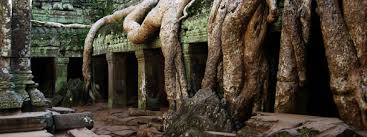
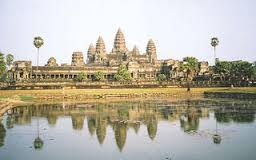
In particular, Angkor Wat(meaning temple) in Cambodia, the largest monument of the Angkor group and the best preserved. The architectural masterpiece's perfection in composition, balance, proportions, relief's and sculpture make it one of the finest monuments in the world.
Angkor Wat represents a miniature replica of the universe in stone. The central tower symbolizes the mythical mountain, Meru, situated at the center of the universe. Its five towers correspond to the peaks of Meru. The outer wall corresponds to the mountains at the edge of the world, and the surrounding moat the oceans beyond.
But new archaeological techniques are now revealing more of its secrets, including an elaborate network of temples and boulevards, and sophisticated engineering.
Angkor Wat represents a miniature replica of the universe in stone. The central tower symbolizes the mythical mountain, Meru, situated at the center of the universe. Its five towers correspond to the peaks of Meru. The outer wall corresponds to the mountains at the edge of the world, and the surrounding moat the oceans beyond.
But new archaeological techniques are now revealing more of its secrets, including an elaborate network of temples and boulevards, and sophisticated engineering.
 en.wikipedia.org
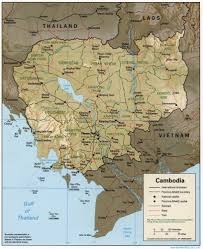
 Back in April 1858 a young French explorer, Henri Mouhot, sailed from London to south-east Asia. For the next three years he traveled widely, discovering exotic jungle insects that still bear his name. During his exploration in the country between Thailand and Vietnam, he wrote a journal published in 1863, two years after he died of fever in Laos, aged just 35.
Mouhot's vivid descriptions of the lost medieval city of Angkor, and it's vast temples consumed by the jungle, captured the public imagination which led to tales of swashbuckling explorers finding forgotten temples.
Today Cambodia is famous for these buildings. The largest, Angkor Wat, constructed around 1150, remains the biggest religious complex on Earth, covering an area four times larger than Vatican City. It attracts two million tourists a year and takes pride of place on Cambodia's flag.
Mouhot's vivid descriptions of the lost medieval city of Angkor, and it's vast temples consumed by the jungle, captured the public imagination which led to tales of swashbuckling explorers finding forgotten temples.
Today Cambodia is famous for these buildings. The largest, Angkor Wat, constructed around 1150, remains the biggest religious complex on Earth, covering an area four times larger than Vatican City. It attracts two million tourists a year and takes pride of place on Cambodia's flag.
Then, last year, archaeologists announced a series of new discoveries about Angkor, and an even older city hidden deep in the jungle beyond.
An international team had mapped 370 sq km around Angkor in unprecedented detail despite the dense jungle and the prevalence of landmines from Cambodia's civil war. Yet the entire survey took less than two weeks using Lidar. Mounted on a helicopter, the team's lidar device fired a million laser beams every four seconds through the jungle canopy in a grid pattern of passes, recording minute variations in ground surface topography.
The findings were staggering.
Beneath the jungle, the archaeologists found undocumented cityscapes, with temples and utterly unexpected grids of ceremonial boulevards, dykes and man-made ponds spreading across the landscape. A lost city, found.
An international team had mapped 370 sq km around Angkor in unprecedented detail despite the dense jungle and the prevalence of landmines from Cambodia's civil war. Yet the entire survey took less than two weeks using Lidar. Mounted on a helicopter, the team's lidar device fired a million laser beams every four seconds through the jungle canopy in a grid pattern of passes, recording minute variations in ground surface topography.
The findings were staggering.
Beneath the jungle, the archaeologists found undocumented cityscapes, with temples and utterly unexpected grids of ceremonial boulevards, dykes and man-made ponds spreading across the landscape. A lost city, found.
The large-scale hydraulic engineering, the defining signature of the wealthy Khmer empire, channeled precious seasonal monsoon water using a complex network of huge canals and reservoirs. However, it fell into disrepair. At the end of the medieval period, the dramatic shifts in climate across south-east Asia led to Angkor's collapse from which it never recovered.
The lidar map reveals catastrophic flood damage to the city's vital water network. Tree ring samples record sudden fluctuations between extreme dry and wet conditions at that time.
In the 15th Century, the Khmer kings abandoned their city and moved to the coast. They built a new city, Phnom Penh, the present-day capital of Cambodia.
I love learning about the history of mankind. And now, the wonder of technology pin-points the need to maintain any civilization's basic structure.
I suggest you attend to your own roots before you go off searching for gold in the hidden city.
The lidar map reveals catastrophic flood damage to the city's vital water network. Tree ring samples record sudden fluctuations between extreme dry and wet conditions at that time.
In the 15th Century, the Khmer kings abandoned their city and moved to the coast. They built a new city, Phnom Penh, the present-day capital of Cambodia.
I love learning about the history of mankind. And now, the wonder of technology pin-points the need to maintain any civilization's basic structure.
I suggest you attend to your own roots before you go off searching for gold in the hidden city.







 RSS Feed

