 news.bbc.co.uk
 On yesterday's blog, several people expressed an interest in how scientists determine diet from ancient bone fragments, or more specifically from King Richard 111's skeleton.
From a folk song:
Dem bones, dem bones, dem dry bones,
Dem bones, dem bones, dem dry bones,
Dem bones, dem bones, dem dry bones,
Now shake dem skeleton bones!
The toe bone's connected to the foot bone,
The foot bone's connected to the ankle bone,
The ankle bone's connected to the leg bone,
Now shake dem skeleton bones! ...
I guess none of us, the ordinary people, will ever understand how chemistry works. You need to be an expert.
From a folk song:
Dem bones, dem bones, dem dry bones,
Dem bones, dem bones, dem dry bones,
Dem bones, dem bones, dem dry bones,
Now shake dem skeleton bones!
The toe bone's connected to the foot bone,
The foot bone's connected to the ankle bone,
The ankle bone's connected to the leg bone,
Now shake dem skeleton bones! ...
I guess none of us, the ordinary people, will ever understand how chemistry works. You need to be an expert.
From Archaeological Research Services Ltd. Human Bone Analysis, or osteology, is the scientific study of bones and teeth and is used to gain an insight into past peoples and societies. The purpose of examining a skeleton is to determine information such as the individual's sex, age at death, cause of death, disease or 'pathologies' suffered during life, stress on the bones, trauma from breaks or combat, burial type and burial traditions. Together this information can be used to reconstruct the probable lifestyle of the individual. Analysis of a group of skeletons can be used to assess the skeletal 'population' as a whole in order to enhance our knowledge of what life was like in the past.
Here's another example of how the multi-isotope analysis works from the Journal of Archaelogical science. Click for full detail.
The discovery of the mortal remains of King Richard III provide an opportunity to learn more about his lifestyle, including his origins and movements and his dietary history; particularly focussing on the changes that Kingship brought. We analysed bioapatite and collagen from sections of two teeth which formed during Richard's childhood and early adolescence, and from two bones: the femur (which averages long-term conditions), and the rib (which remodels faster and represents the last few years of life). We applied multi element isotope techniques to reconstruct a full life history. The isotopes initially concur with Richard's known origins in Northamptonshire but suggest that he had moved out of eastern England by age seven, and resided further west, possibly the Welsh Marches. In terms of his diet, there is a significant shift in the nitrogen, but not carbon isotope values, towards the end of his life, which we suggest could be explained by an increase in consumption of luxury items such as game birds and freshwater fish. His oxygen isotope values also rise towards the end of his life and as we know he did not relocate during this time, we suggest the changes could be brought about by increased wine consumption. This is the first suggestion of wine affecting the oxygen isotope composition of an individual and thus has wider implications for isotope-based palaeodietary and migration reconstructions.
Want more detail? Principles of Stable Isotope Analysis
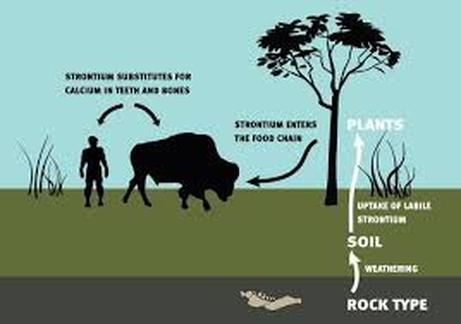
Carbon and nitrogen isotope ratios in human bone may be used to reconstruct prehistoric diet because of differential fractionation, between certain plant groups, of atmospheric carbon dioxide during photosynthesis and of nitrogen during fixation or absorption. There are two stable isotopes each of carbon (12C, 13C) and nitrogen (14N, 15N), with 12C and 14N by far the most common in nature. Small differences in the ratios of these isotopes (12C/13C, 15N /14N) can be measured by isotope ratio mass spectrometry using samples smaller than 1 milligram. High precision isotope measurements are reported using the delta notation (d13C, d15N) relative to internationally recognized standards and are expressed in parts per thousand or per mil (‰).
 Time Team - www.pbs.org
 Okay, that's the science bit. But what does it mean to you and me?
I'll tell you about me. I started off life strong, healthy and tall, far taller than anyone I knew back in the days of rock 'n roll. It's hard for a girl to find a partner if their head is in the clouds.
As I aged, I didn't notice any sign of weakness. But during a hip replacement operation, my femur shattered. What? The strongest, largest bone in the body snapped? From that, tests revealed I'd developed osteoporosis, a weakening of the bone. I now take a daily does of calcium with vitamin D, and a weekly tablet containing alendronic acid, which should keep the bones strong.
All I can say is: I'm glad clever scientists can test for irregularities.
I'll tell you about me. I started off life strong, healthy and tall, far taller than anyone I knew back in the days of rock 'n roll. It's hard for a girl to find a partner if their head is in the clouds.
As I aged, I didn't notice any sign of weakness. But during a hip replacement operation, my femur shattered. What? The strongest, largest bone in the body snapped? From that, tests revealed I'd developed osteoporosis, a weakening of the bone. I now take a daily does of calcium with vitamin D, and a weekly tablet containing alendronic acid, which should keep the bones strong.
All I can say is: I'm glad clever scientists can test for irregularities.







 RSS Feed

